
The different SEGA mascots before Sonic: why him?
1485 words | Reading time: 8 minutes
Behind the ScenesAlex KiddProject Needlemouse
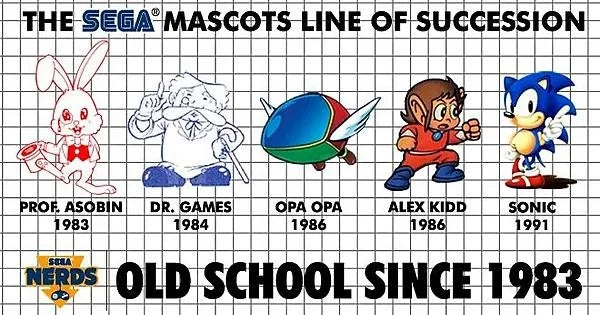
SEGA tried Alex Kidd, Opa-Opa, Flicky, Teddy Boy and Wonder Boy before finding its emblem. Founded in 1960 under the name Service Games, the firm lived off the arcades until the success of the NES, in 1985, forced the battle of the mascots. Alex Kidd, launched in 1986 on Master System, suffered from a shifting design; Wonder Boy remained shared with Westone. In 1990, Project Needlemouse produced a hedgehog as blue as the logo, shod in red in the manner of Michael Jackson, built for the Mega Drive's scrolling and for the "Genesis Does What Nintendon't" campaign.
Before Sonic, SEGA tested several mascots without success: Alex Kidd, Opa-Opa, Flicky… Discover why Sonic became the eternal face of SEGA.
Summary
- SEGA before the mascot era: the arcade years
- Alex Kidd: the first real attempt
- Opa-Opa and the Fantasy Zone series: charm without power
- Forgotten mascots and ephemeral attempts
- Why Sonic? The advent of a perfect mascot
- Sonic's cultural impact
- What the history of SEGA mascots teaches us
- Summary table of SEGA mascots before Sonic
- FAQ
SEGA before the mascot era: the arcade years
When we mention SEGA today, the image of the ultra-fast blue hedgehog immediately comes to mind. However, before Sonic became the undisputed emblem of the Japanese company, SEGA experimented with several iconic characters to represent its brand.
Founded in 1960 under the name Service Games, SEGA first established itself as a major player in the arcade industry. At that time, the idea of a mascot was not a priority: the arcade cabinets were sufficient to identify the brand.
It was truly the arrival of Nintendo and Mario in the home console market – especially after the success of the NES in 1985 – that pushed SEGA to consider a strong mascot. The rivalry then became a brand identity war.
📱 After the success of the NES in 1985, the rivalry turned into a brand identity war and SEGA still had no face to set against Mario; the one it finally found, you keep on the back of your phone with our Sonic iPhone cases.

Retro vibe
Retro Sonic Mug
A vintage design mug to pay homage to the era when Sonic became the eternal face of SEGA.
€39.90
View product →Alex Kidd: the first real attempt
In 1986, SEGA launched Alex Kidd in Miracle World on Master System. This young hero with big ears, inspired by Dragon Ball, became SEGA's first official mascot.
- Gameplay combining platforming, combat, and puzzles
- Colorful graphics and varied universe
- Originality of rock-paper-scissors as a central mechanic
Despite several sequels (Alex Kidd in the Enchanted Castle on Mega Drive), Alex Kidd never achieved Mario's popularity: too many design changes and inconsistencies between episodes blurred his image.
✂️ On the Master System, Alex Kidd in Miracle World settled its duels with rock-paper-scissors, a rule that still needs two players sitting face to face: that is exactly the ground covered by our Sonic board games, around your table.

Opa-Opa and the Fantasy Zone series: charm without power
With Fantasy Zone (1986), SEGA introduced another character: Opa-Opa, a small, cute, sentient spaceship. This cute'em up contrasted with the dominant military shooters like Gradius.
While Opa-Opa made its mark in arcades, its mascot status remained limited due to:
- the niche genre of shoot'em up,
- an undeveloped personality,
- a universe rarely explored outside of arcades.
Forgotten mascots and ephemeral attempts
- Flicky (1984): a small blue bird, star of a simple arcade game; he reappears in Sonic 3D Blast, but remains secondary.
- Teddy Boy (1985): hero of a game linked to a Japanese song, too anecdotal to break through outside Japan.
- Wonder Boy (1986): very popular; developed by Escape (later Westone), which retained the rights to the game code while SEGA owned the "Wonder Boy" brand and characters – SEGA also largely continued to publish the series.
Why Sonic? The advent of a perfect mascot
In 1990, SEGA began developing a new mascot under the code name Project Needlemouse: an internal design process (led by the Sonic Team) to create a character capable of competing with Mario. The result was a super-fast blue hedgehog: Sonic the Hedgehog, whose first game was released in June 1991 on Mega Drive / Genesis.
1. Speed-focused gameplay
Sonic exploited the fluid scrolling of the Mega Drive: players experienced unprecedented speed and witnessed the console's technical superiority.
2. Immediately recognizable design
- Blue like the SEGA logo
- Red shoes inspired by Michael Jackson and Santa Claus
- Confident gaze, rebellious attitude
3. A "cool" attitude to attract young people
Sonic embodies the 90s teen culture: rebellious, energetic, opposed to Mario's good-natured tone.
4. A technical demonstration
Rotation effects and multiple scrollings made Sonic a technological showcase for SEGA.
5. Aggressive marketing strategy
The "Genesis Does What Nintendon't" campaign established Sonic as a cool alternative to Nintendo.
🧶 Confident gaze, rebellious attitude, 90s teen culture: against Mario's good-natured tone, SEGA first set a look, and a look is something you wear — our Sonic sweaters take care of that in your wardrobe.
Sonic's cultural impact
- Over 15 million copies sold (with bundles)
- Three animated series in the 90s
- Hundreds of merchandise products
- A successful film in 2020 and its sequel in 2022
Sonic became one of the few characters to rival Mario in global notoriety.
What the history of SEGA mascots teaches us
- Timing matters: Sonic arrived when SEGA needed an emblem to challenge Nintendo.
- Strong identity > quantity: Sonic, unlike Alex Kidd, has a clear and consistent personality.
- Technical innovation: Sonic leveraged the power of the Mega Drive.
- Massive marketing: the campaign transformed Sonic into a cultural phenomenon.
Summary table of SEGA mascots before Sonic
| Character | First Appearance | Strengths | Reasons for Failure |
|---|---|---|---|
| Alex Kidd | 1986 – Alex Kidd in Miracle World | Varied gameplay, identifiable hero | Changing design, weak marketing |
| Opa-Opa | 1986 – Fantasy Zone | Cute design, unique gameplay | Niche genre, limited personality |
| Flicky | 1984 – Flicky | Arcade charm, simplicity | Too limited universe |
| Teddy Boy | 1985 – Teddy Boy Blues | Japanese music license | Restricted audience, few extensions |
| Wonder Boy | 1986 – Wonder Boy | High popularity, solid gameplay | Shared rights with Westone (game code) |
FAQ
-
Who was SEGA's mascot before Sonic?Mainly Alex Kidd from 1986.
-
Why didn't Alex Kidd succeed?Inconsistent design, limited marketing, and competition from Mario.
-
Did SEGA consider other mascots?Yes: Opa-Opa, Flicky, Teddy Boy, etc.
-
Why did Sonic prevail?Fast gameplay, strong design, aggressive marketing campaign.
-
Does Alex Kidd still exist?Yes! Alex Kidd in Miracle World DX (2021) modernizes the original game.